A big diesel's turbocharger spins on a thin film of engine oil, and it stays hot and keeps coasting for a while after the engine stops. If you shut down right after a hard pull, oil flow stops while the turbo is still hot, and the oil trapped inside can cook into carbon. A few minutes of idling lets the turbo slow down and cool while oil is still flowing.
That is the short version. Below is how a turbo works, why it is so sensitive to oil, and when the cool-down habit matters most.
What does a turbocharger actually do on a big diesel?
A turbocharger forces extra air into the engine's cylinders. More air means the engine can burn more fuel in each cycle, and that means more power. This is how a modern diesel makes serious pulling power from its displacement.
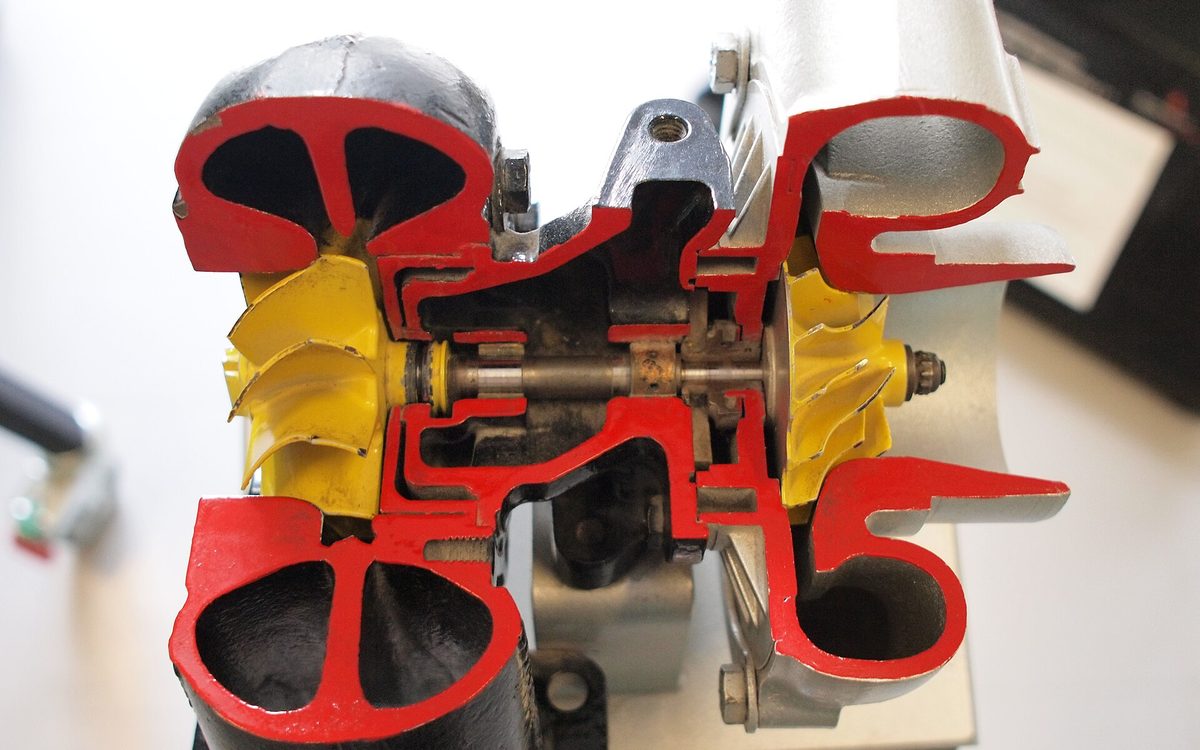
The turbo has two wheels connected by one shaft. The turbine wheel sits on the exhaust side, and the compressor wheel sits on the intake side. Hot exhaust gas rushes out of the cylinders and spins the turbine. The shaft carries that spin to the compressor, which packs air toward the cylinders.
Is the turbo belt-driven?
No. A turbocharger has no belt and no gears. It runs on exhaust energy that would otherwise leave through the stack unused.
That is the main difference from a supercharger, a different kind of air pump that the engine drives mechanically. A supercharger takes power from the engine to make power. A turbo recovers energy that was going to be thrown away.
Why does it whistle, and what is turbo lag?
The whistle comes from a part spinning at a speed that few other parts on your truck can match. Turbo shafts commonly turn at tens of thousands of RPM or more, far beyond the crankshaft or anything else rotating on the truck. At that speed, the sound of air moving through the compressor is hard to miss.
The turbo only works as hard as the exhaust pushing it. At low RPM there is little exhaust, so boost (the extra air pressure the compressor builds) rises slowly. That delay is turbo lag.
Put the engine under load and exhaust energy climbs, so the turbine spins up faster and boost builds quickly. That is why a loaded truck on a grade feels strong once the turbo is working, and why a lightly loaded engine at low RPM feels softer.
What keeps a turbo spinning at that speed without wrecking itself?
Engine oil. The shaft rides on bearings fed by oil from the engine's lubrication system. The oil does two jobs:
- It lubricates, with a thin film of oil between the spinning shaft and the bearing so metal does not touch metal.
- It carries heat away from the bearing area, which sits right beside the red-hot turbine side.
The turbo lives next to exhaust gas that is very hot, and the oil is what keeps the middle of the assembly from cooking. As long as the engine runs and oil pressure is up, the oil keeps flowing and the turbo stays protected.
Why do drivers say to let it idle before shutting down?
Because the turbo does not stop the moment the key turns. After a hard pull, the turbine wheel is hot and still spinning, and it coasts down over time. Shut the engine off, and the oil pump stops sending oil to the bearings while the housing is still very hot.
The oil left in that hot housing has nowhere to go and can break down. Over time it turns into hard carbon deposits, which is called coking. Coked oil can restrict oil passages and wear the bearings, and a worn turbo can fail early. Oil coking is a well-documented turbo failure mode in turbo makers' guidance and in engine operator manuals.
Idling for a few minutes after hard running fixes this. The turbo slows down, temperatures come down, and oil keeps circulating the whole time. The exact length varies by manufacturer, so "a few minutes" is the honest answer.
When does the cool-down matter most?
It matters most after heavy work. Think of a loaded climb, a long hard highway run at high load, or any stretch where the engine made lots of heat and boost. After that kind of work, the turbo and exhaust side are at their hottest.
If you have been running light or coasting down a long grade, the turbo is not as hot, and less cool-down is needed. Manufacturers tie their cool-down advice to load and operating conditions, so how hard you just worked the engine is the key question.
A couple of related habits are worth knowing:
- Do not rev the engine right before shutting it off. It spins the turbo up just as the oil supply is about to stop.
- On a cold start, let oil pressure come up and go easy on the engine at first, since the turbo depends on oil reaching it.
Do newer engines still need a cool-down?
Some need less. Many modern turbos have water-cooled bearing housings, which means engine coolant helps pull heat out of the turbo. That makes oil coking less of a worry than on older designs that rely mostly on oil for cooling.
Some engines also have software or hardware that manages shutdown or limits how the engine behaves under heavy load. Requirements differ from one engine and one manufacturer to the next.
The engine's operator manual is the final word. If it gives a cool-down time or condition, follow that over shop talk or habit. If you drive more than one truck, check each one's manual rather than assuming they all want the same thing.
What about anti-idling rules?
Idling rules are a separate matter, and they vary a lot. Many states, provinces, cities and some ports have limits on how long a heavy truck may idle. The details, the exceptions, and the penalties differ by location, and Canada's rules are set by province and often by municipality.
A short turbo cool-down is generally brief compared with the long idling those rules usually target, but do not assume you are exempt. Check the rules for the places you run, and ask your carrier what it expects. If your engine manual calls for a cool-down, that is a good thing to be able to point to.
The simple version
Exhaust spins the turbo. Oil keeps it alive. A short cool-down after hard running protects it when the engine goes quiet. Know what your engine's manual says, and follow it.